Learn how divorce affects children, including symptoms and long-term impact. Get expert advice on how tot ell kids about divorce and find appropriate therapy.
Children live within the context of their relationships. They are cared for by their mothers, fathers, aunties, poppas, uncles, grannies, nanas, family friends, childcare providers, all the various important people that are considered family to them.
Each family is different, and therefore every divorce is different. The one thing that is often the same for every family is that divorce is a change from how things have been to a new way of being a family. In the best of circumstances this is done amicably, but often it can be difficult.
Major life changes that divorcing families are adapting to include:
Parents often ask us how to support their children through a divorce, and they are onto something important: Supportive parenting can boost kids’ resilience and help them adapt to the big changes that can be brought about by divorce. In the wake of these changes, children can be stressed and anxious.
We'll talk about these common concerns for families:

When thinking about the impact of divorce on children, it’s important to start with a basic understanding of attachment.
“Attachment” is a bond that provides:
—> Safety, security, connection that is essential for the survival of all mammals.
—> A foundation from which a child can learn to:
Children feel secure when their caregivers are available and responsive to their emotions.
Separation from caregivers can sometimes trigger “attachment stress” in children’s lives. Kids often worry about how all the changes will impact them and without support and reassurance might wonder if they will still be loved and taken care of.
Some common concerns for kids:
It is also a sensitive time for parents, who may be dealing with their own raw emotions and concerns. For parents, a divorce can represent a severing of connection to someone who was once a safe and secure base… It can feel like the “death” of a family that once was.
There is a grieving process that each family member moves through in their own way and at their own pace.
During that grieving process, you might notice behavior changes across different areas of your child’s life.
Your child may:
These changes are typically temporary as your child adjusts but some kids experience long-term impacts after a divorce.
Children in divorced families can be at higher risk for:
While there is a risk this is not a certainty! Research shows that safe, nurturing and stable relationships buffer children’s experiences of adversity and help them become more resilient. Your relationship with your child can be a source of strength for both of you as you adapt to your family’s new configuration.
For many parents the biggest concern when considering a divorce is the impact it will have on their child. We want to reassure you that there are many things you can do to buffer the impacts of a divorce on your child.
We’ll go over signs of stress in your child so you can keep a close eye on their wellbeing and step in early to avoid long-term impacts.

Many parents wonder how their child is really feeling about the divorce.
It can be hard for kids to describe their feelings, because….
Stress in children can show up in their behavior first.
Initially you may notice your child:
This will often resolve as things become more predictable but some kids will have a delayed reaction to big changes.
Signs we recommend looking out for:
You can also spot signs of stress in your child by looking for changes in their academic and social life.
You might get reports from your child’s school that they are:
If you notice any of these signs of stress, it is important to take time to provide emotional and relational support.
Here are some ways to help:
Many parents struggle with self-doubt related to their divorce. You might:
One important thing to remember is that parents are a child’s first role model. Parents who make courageous decisions for their own wellbeing are teaching their child about healthy relationships and being brave in the pursuit of a better life.
The idea of "self-care" can feel hard for parents in today’s culture that tells us to self-sacrifice for our kids. In our efforts to make life gentler on our children, we might end up behaving in ways that don’t contribute to the household’s overall wellbeing. That being said...There is no one answer that works for all families.
Families may decide to:
All of these choices are ok! Children do best when their parents are safe, regulated, and happy. This allows them to help their child be safe, regulated, and happy too. In an emergency, airplane passengers are always reminded to put their own oxygen mask on before helping others. The same principle applies to parents’ decision-making about divorce: Make sure your own needs are met, so you can better support your family.

Talking to your kids about divorce is an emotionally charged experience, and parents often wonder how to make their announcement in a gentle, supportive way.
One of the best ways to make the announcement process gentle for your child is to adapt it to their developmental stage. A child’s developmental stage impacts how they absorb and understand new information.
Here are some considerations for developmentally appropriate conversations about divorce:
Infants won’t understand what is going on, but they do sense their parents’ feelings and react to them (e.g., Dad is sad so the baby feels sad; fussing; crying; having trouble sleeping or eating).
At this age, you can stick to a simple explanation about you and the other parent not living together anymore.
Picture books for infants: Two Homes by Claire Masurel. Picture books can help your child build a concept of what it means to live in two places and normalize the feelings that come with changes in routine.
Toddlers and preschoolers will be able to understand that a divorce means a big change. They will likely need to hear about the divorce many times and ask many repetitive questions. Toddlers and preschoolers are still building their understanding of concepts like time and object permanence, so they will need some support to understand what is happening and why.
At this age, you can explain how it will affect your child and provide reassurance about the strength of your relationship to them. You might try-
→ “Mama and I will not be living together anymore. So sometimes you will stay with her, and sometimes you will come stay with me. But we will always be your parents and you will always be our child, and we will always love you and care for you.”
Books for preschoolers: Dinosaurs Divorce by Laury Krasny Brown and Marc Brown, Was It The Chocolate Pudding? by Sandra Levins, and Why Do Families Change? by Dr. Jillian Roberts.
School-aged kids will understand that a divorce means their parents will no longer be married or live together. Oftentimes children will wonder why their parents are separating and because at this stage children are “self-centered”, many may wonder if they have done something to cause it. At this age, it is important to emphasize that a divorce is a “grown-up problem” and it is not their fault.
You can prepare a brief explanation about why you have chosen to separate. This might sound like,
→ “Dad and I fight with each other a lot when we live together, so we decided it would be better for everyone if we live in different houses. This is something your dad and I decided together and has nothing to do with anything you did. We both still love you and will both still take care of you.”
Just as with younger kids, make sure to provide reassurance about the strength of your relationship to them.
→ “Even though there will be some big changes, we will both always love you”
School age books such as Divorce is Not the End of the World by Zoe Stern and Evan Stern can serve as a support for navigating the changes in family dynamics and understanding the feelings that come up.
There can be a delayed reaction to receiving the news. Your child might not react much during the initial conversation, but have bigger feelings later on. It’s helpful to be prepared for ongoing discussions, as your child processes the news.
We often encounter “parental perfectionism” where parents are critical of themselves when they don’t do things perfectly. Make sure to give yourself grace. If you feel that something in your initial discussions with your kids didn’t go well, you can always talk about it again.
Be sure to check out other great resources online to support parents in preparing for this conversation such as this resource from Zero to Three.
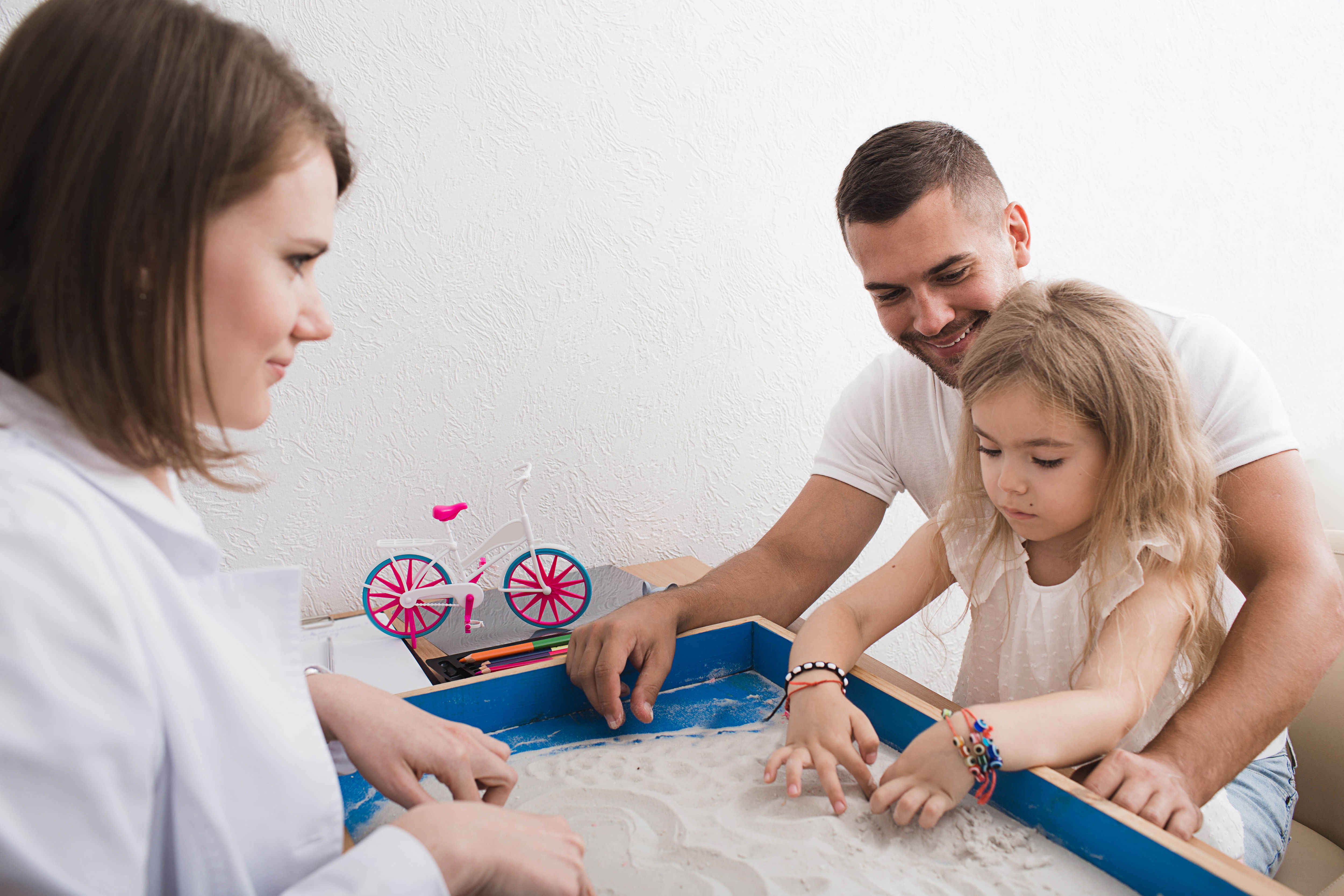
In many cases, kids would benefit from therapeutic support in addition to their parents’ best efforts. If you notice signs of stress in your child or are in any way concerned with how they are adjusting, therapy can be a great source of support for your family.
When seeking a therapist for your child, it is important to find someone who has received specialized training in child therapy.
Children are not very good at sitting down and telling you what they are thinking and feeling. They need someone who speaks their language and understands their unique needs.
Child therapists use play-based therapy to help children express emotions, process experiences, and build healthy relationships. This looks different from adult therapy, with less direct talking about the “problem”. The child therapist is trained to integrate the child’s “problem” into the play so it can be tolerated and worked more easily. At the Center for Early Childhood Connections, we work with very young children (birth to eight) and utilize a child-parent framework to support families.
Child parent-psychotherapy is a therapy for young children and their caregivers that helps kids heal in the context of their family relationships. In this type of therapy, kids come to sessions with one or both parents so that the child is supported in the context of their relationship with their caregiver.
A great child therapist should:
When choosing a therapist, it is important to find someone you and your kid feel comfortable with: someone you feel seen and understood by. A big part of this is finding a professional who is committed to understanding you in the context of your specific family and culture.
At the Center for Early Childhood Connections, our work is grounded in the Diversity-Informed Tenets for Work with Infants, Children, and Families, which offers a framework for practice that honors families’ diverse ways of being. As you begin researching therapy options, we recommend scheduling an intake or consultation call, so you ask any questions that you have.